Recently I’ve spent more time with my new Mompreneur website and hardly update blog post here. I’ve checked my Google Analytics for this website today and surprise to find that I still have the constant traffic and some traffic are from the google organic search results.
I’m actually quite surprise to see my website get rank at the first page and even the #1 for some keywords. Let’s share with you some keywords that rank my site in the first page of SERP.
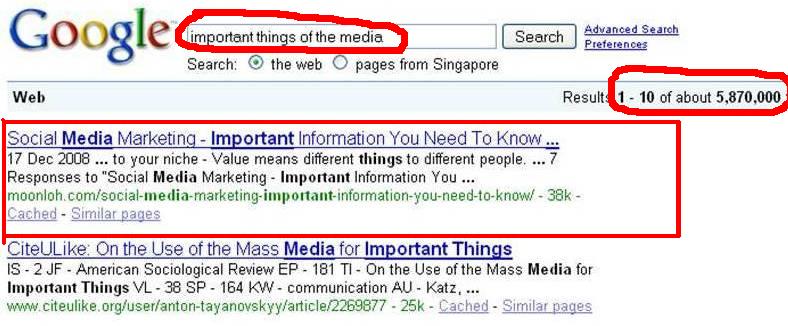
Keyword-Important things of the media, Rank-#1
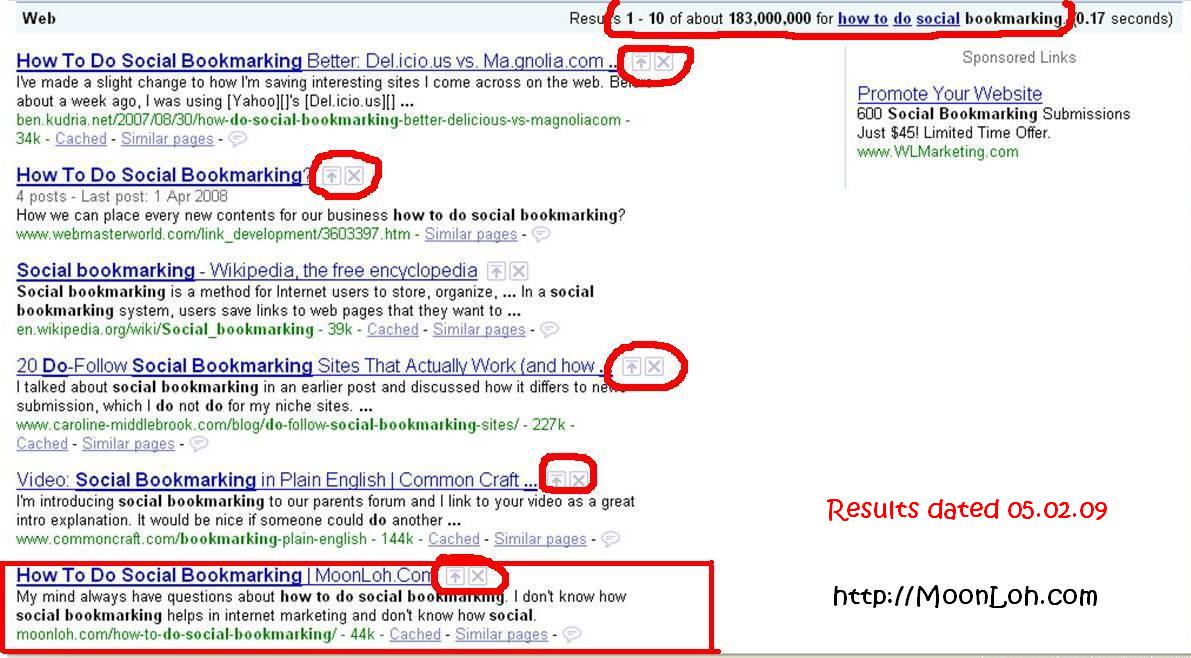
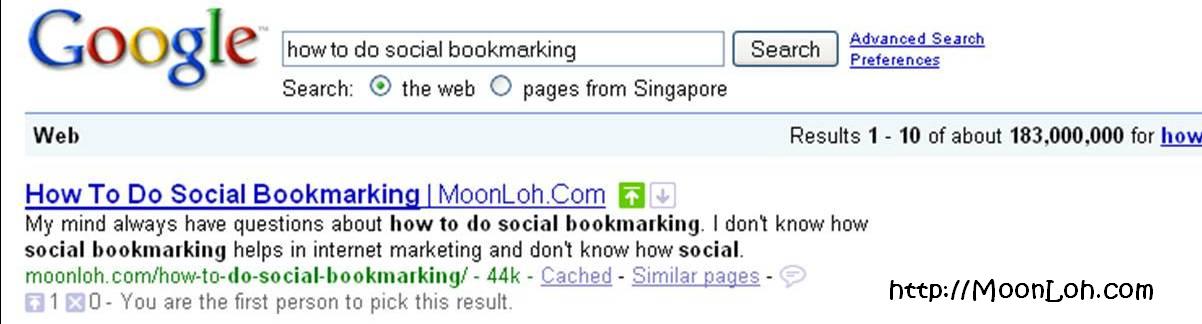
Keyword-How to do social bookmarking, Rank-#6

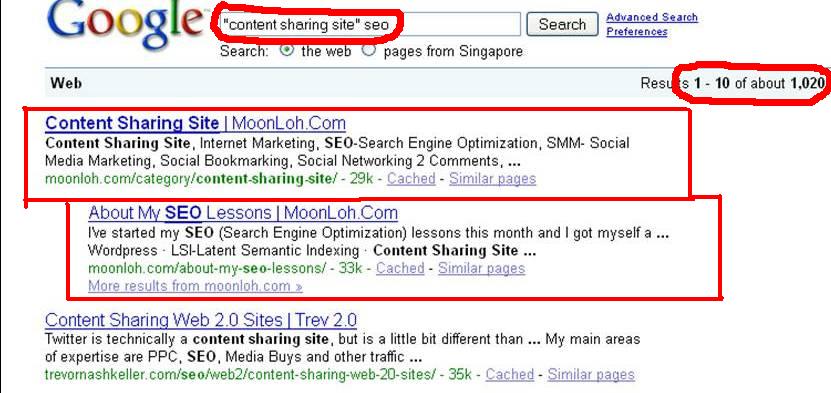
Keyword-”Content sharing site” seo, Rank-#1 & #2
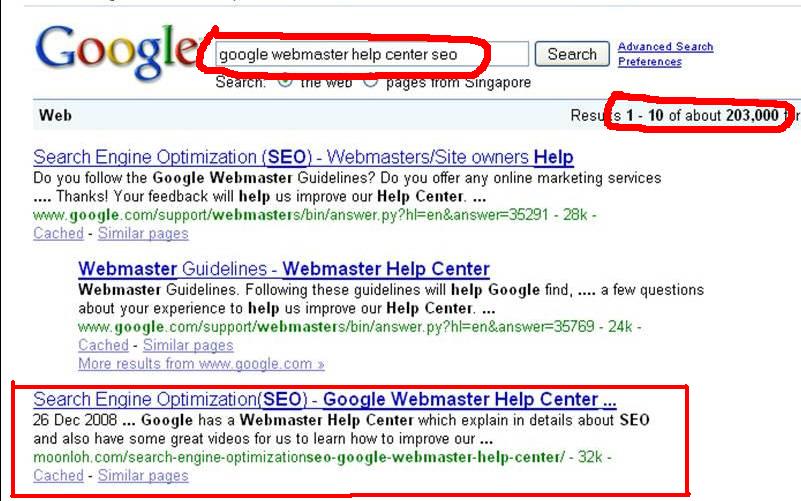
Keyword-Google webmaster help center seo, Rank-#3
Keyword-Lsi site creator, Rank-#5
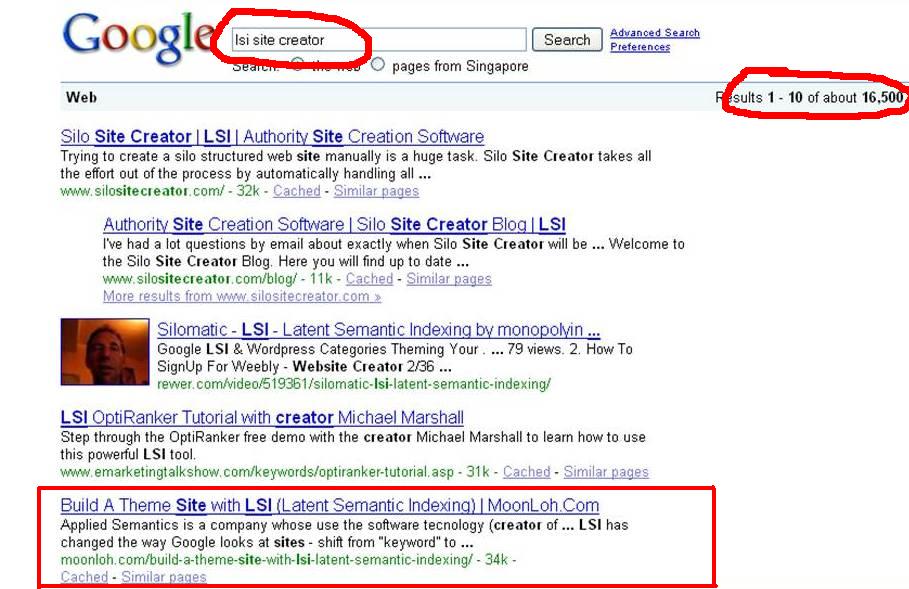
These are the results of 19.01.09 and my Page Rank=2, Alexa Ranking=684,881
If you ask me whether a website with Page Rank 0 can get rank in the first page of SERP, let me show you the following:
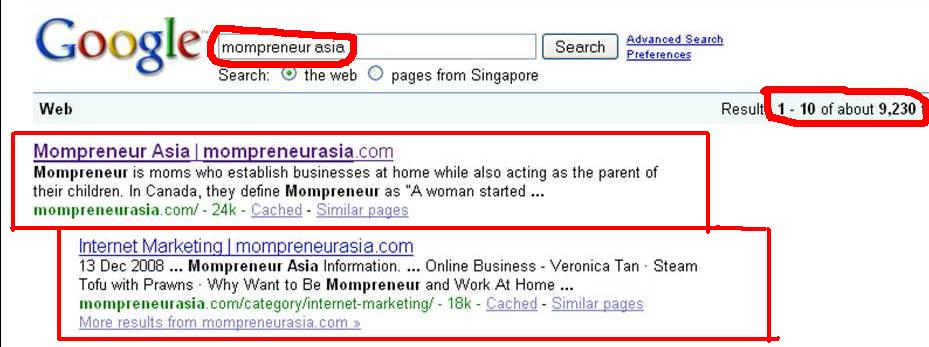
My Mompreneur website only launched last month and the PR=0 but still get rank in first page #1 and #2 of the Google Organic Search Results. Therefore, try to focus on your website’s SEO and LSI to attract more free traffic and don’t worry about your Page Rank.
You can read more about my posting of SEO and LSI here.
I’ve started my SEO (Search Engine Optimization) lessons this month and I got myself a new notebook since my last notebook already full with all the social media marketing notes.


Compare to social media marketing, I find SEO more technical and less interesting. However, it’s always good to learn new things and SEO is a crucial part of internet marketing.
Page Rank = SEO Tips + Persistence
SEO (Search Engine Optimization) is the foundation for almost every form of online advertising and we need to know:
• what a meta tag is and how to use them
• what keywords are
• how many keywords to use
• where keywords should be placed and why
• what title tags are
• what alt tags are
• what header tags are
• what a sitemap is and how to use the different kinds
• why links can help or hurt you
• why commenting is a good thing
Some SEO Tips
- Content
- Individual Title and Descriptions
- Site Architecture / Navigation
- Inbound links to your site from relevant and trusted sites
- Keyword Terminology
- Universal XML Sitemaps
- Rich Media
- Web 2.0
- Mobile Web
- Content Relevancy
- Constant Monitoring of Paid and Organic Analytical Information
- Become a More Trusted Site
More SEO Tips
- Site Design Consideration
- Don’t use frames
- Don’t use dynamic URL’s
- Don’t have an entirely FLASH homepage
- Don’t use image maps as the only method of navigation
- Don’t use javascript as hte only method of navigation
- Carefully choose your keywords
- Optimization of your Title Tag
- Optimization of your page content
- Optimization of your META tags
- Optimization of your images using “alt”
- Optimization of your Text Hyperlinks
- Optimization of Heading Tags
- Wait for 4-6 weeks before re-submit to Google
- Things to avoid ~ Optimization for Search Engines
I have discussed about LSI – Latent Semantic Indexing in my previous blog post “What is LSI” but not go into detail. Today let’s see some history of LSI.
Applied Semantics is a company whose use the software tecnology (creator of CIRCA) to extract and organize information from websites in a manner similar to the way that humans might act. The software technology arose from the shortage of finding the valuable content for the advertising of Adsense ads. As you may know, Adsense ads matched the keywords on the pages to keywords in the ads and a webmaster earned money for every click he received from an ad shown on his website. Google soon found the problems of those webpages simply contain relevant keywords phrases to capture traffic for the Adsense ads without valuable content. The software technology of Applied Semantics thus plays an important role in solving this problem. In year 2003, Google purchased Applied Semantics.
The exact mathematical formula used for LSI is complicated and it analyzes pages not only for keywords, but for processing documents based on keyword themes. So its real function is to determine if the content of a site is of value to the visitor or not. Since Google found LSI technology useful and has been implementing it into its ranking algorithm, we should understand and deploy on our websites.
We have some basic knowledge about LSI (Latent Semantic Indexing), here we see how some words have other meanings to Google under the LSI.
When we perform search for the word “laptop” using Google, the returns results on the search pages are as follow:
Google BOLDS the search word “laptop”
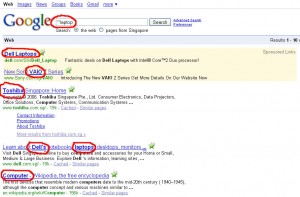
If we run a query using the LSI commands which is a ~ sign in front of the search word “~laptop”, Google will show the search results as follow:
With LSI, you can see that to Google, “laptop” also means: Dell, VAIO, Toshiba, Computers.
LSI has changed the way Google looks at sites – shift from “keyword” to “themes”. It based on the concept that humans are not looking for pages that contain specific keywords but for sites build around a theme.
Related post:
When most of us focus on the word SEO (Search Engine Optimization) to achive page ranking success, there is another key to page ranking success – LSI (Latent Semantic Indexing).
People always say “Content is King” and we always focus on the great content and wanted our articles to be found on search engines and therefore those articles were written with SEO in mind. Now, Let’s find out what is LSI and why it is the key to page ranking success.
LSI is Latent Semantic Indexing. It is a way for search engines to view and rank web pages in a more natural, or human manner. In other word, LSI helps search engines to find out what a web page is all about and it basically means that you shouldn’t just focus on a single keyword when optimizing our web pages and when getting links. LSI not only takes into account a keyword or phrase but also other words and phrases that are similar.
Let’s look at this example. When we want to write an article with the keyword of “buy dress”, we would include this keyword in the article about 3% for SEO purposes. However, with LSI we need to include “buy dress” a few times and also want to include other phrases like “buy clothes”, “buy long dress”, “get dress” and “purchase dress”. The article will then ranked higher in the search results because according to LSI, this article will have more value compare to only target the keyword of “buy dress”. Instead of one keyword or keyword phrase being used as anchor text, a variety of anchor text is favoured.
With the introduction of LSI, sites that previously were ranked high because of extensive inbound links based on a single keyword have now found their ranking have dropped.


 If There's a will, There's a way!
  is my motto.