Would you limit your web site traffic? Your first reaction about this question might be, “No way! I don’t limit the amount of traffic coming to my web site, I want traffic and more traffic to my web site the better!” So, more traffic means right traffic? Sometimes it does not seems all the traffic are the right traffic you get.
I give you one of my example. I have one article “Will the AIG Crisis affect Singapore” and this particular article drive me lots of traffic. However, this article does not have anything to do with internet marketing and most of the readers just read the article and leave. So, I realise that these traffic is of little or no use to my business.
Get the right traffic
I welcome traffic to my web site and the more traffic the better. However, I prefer to get more right traffic instead of high bounce rate traffic. I ever described our web site is a “location” for us to advertise and market our product, just like a traditional business man needs a shophouse for selling (my post – Is webpage and website related to feng shui?!). And since our web site is our shop, we need to get the customers to come and eventually “buy” something. Therefore, getting the right traffic is important in the sense that when we get the right customers through the door of our shop, we’ll sell significantly more.
How to get right traffic
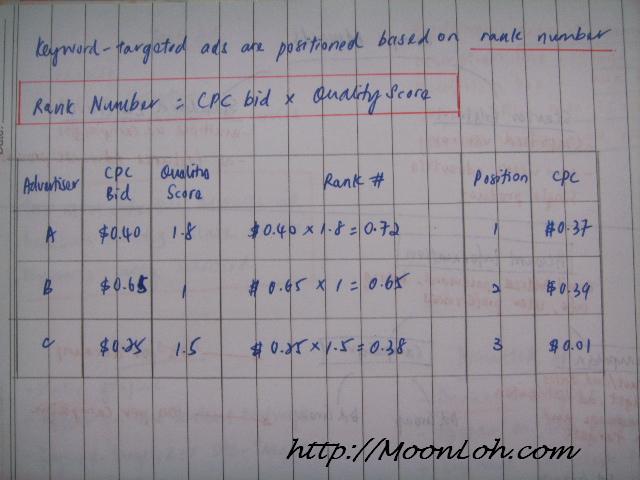
Recently I’ve spent lots of time learning about Internet Marketing and focus in Google Adwords, SEO and Social Media. I have a notebook for my Adwords which I share some handwriting notes with all of you and I have another notebook for SEO and Social Media. See, this is my another notebook and it’s totally full now.


Ok, about getting the right traffic, I’ve also spent time focusing and creating content for my sites on a very specific target market. As a result of making changes, I get some good feedback and the number and quality traffic has gone up significantly. Although it wasn’t happened overnight but I think the time was well worth the investment because some friends are contacting me and we share more in particular areas.
We have probably heard a lot on how to focus on the niches market and get the traffic from the niches. So, I think all of us can approach traffic in the same manner. We just need to think on how to get the relevant traffic and implement something to prevent unrelated traffic. One of the best way is the create relevant content which to your niches and make sure those contents are useful for the person who read the information. Also, the most important is the information relevant to your business, product or service?
I heard from my friends that their websites have many traffic / visitors but they can’t generate good sales. And I also heard from them that they don’t have products but only websites. So, my thinking is, as an internet marketer, we are in business and we shouldn’t only focus on our web site but ignore about our products. Just imagine you have many right customers get through the door of your store but you just let them go with empty hands. Will you do that if you are the boss in real world? Doing business in internet is exactly the same like doing traditional bussiness, the same concept apply here and some people don’t see the whole picture.
Try to focus on the main theme of our website and always creating relevant content is a good way to get right traffic. I’ve learnt a lot about social media and it’s really a powerful tool in internet marketing. I will share more about my findings and recommendations on this area. Of course I will continue to share about the Adwords too. If you would like to know how social media helps to increase quality traffic and how it helps about your products, follow my blog and subscribe to my RSS.
Generally, there are four types of keyword matching in Google Adwords. You probaby know this if you have read the notes from Google Adwords Learning Center. However, I guess still have people who didn’t read from the Learning Center or they have read but sooner they forgot about the keyword match. Here, I just show you my handwriting notes like I always did. I hope you can see the whole picture instead of reading sentence by sentence or watch the video from start till end.
Why keyword match is important?
Keywords are the most important “key” to determine how much you pay for the ad to display. Since it involves money, we better put full attention on it. otherwise the money we invest will turn into a cost instead of investment.

Basically, there are four types of Keyword Match:
- Broad
- Phrase
- Exact
- Negative
I advise you to use all four types of keyword match and see which one work best for you. The keywords you use also closely relate to the traffic your ad could generate.
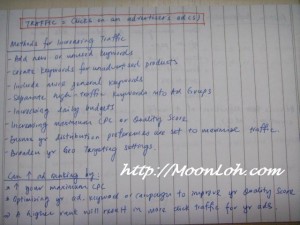
Traffic = Clicks On An Advertiser’s Ad(s)
Methods for Increasing Traffic
- Add new or unused keywords
- Create keywords for unadvertised products
- Include more general keywords
- Separate high-traffic keywords into Ad Groups
- Increasing daily budgets
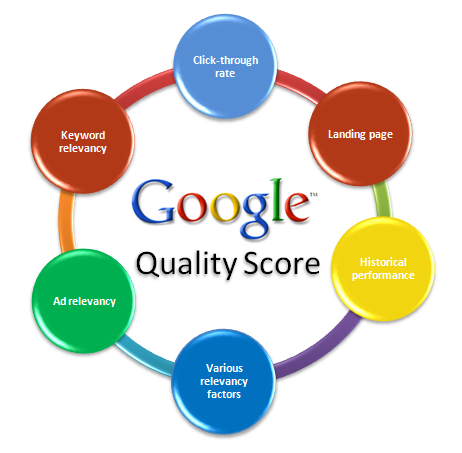
- Increasing maximum CPC or Quality Score
- Ensure your distribution preferences are set to maximise traffic
- Broaden your Geo targeting settings
You can also try to increase your ad ranking because a higher rank will result in more click traffic for your ads.
Two ways to increase ad ranking
- Increase your maximum CPC
- Optimizing your ad, keywords or campaign to improve your Quality Score
In my previous blog post, I’ve share about the Google Network and talked about the Search Network and Content Network. For the Content Network, we focus on Contextual Targeting and today I want to show you my notes about Contextually Targeted Campaign.
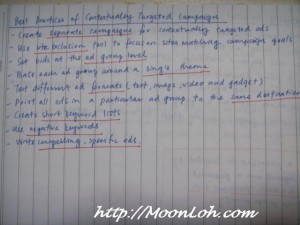
Best Practices of Contextually Targeted Campaign
- Create separate campaigns for contextually targeted ads
- Use Site Exclusion tool to focus on sites matching campaign goals
- Set bids at the ad group level
- Base each ad group around a single theme
- Test different ad formats (text, image, video and gadget)
- Point all ads in a particular ad group to the same destination URL
- Create short keyword lists
- Use negative keywords
- Write compelling, specific ads
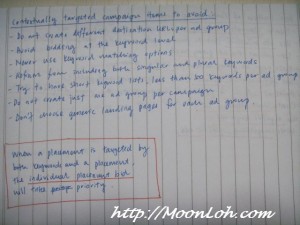
Contextually Targeted Campaign Items to Avoid
- Don’t create different destination URLs per ad group
- Avoid bidding at the keyword level
- Never use keyword matching options
- Refrain from including both singular and plural keywords
- Try to have short keyword lists, less than 50 keywords per ad group
- Don’t create just one ad group per campaign
- Don’t choose generic landing pages for each ad group
These are the points that I think we should take note and every points are equally important.
If you have any points to add in, don’t hesitate to let me know.
I’m thinking how to share about my learning of Google Adwords because after I’ve studied all the topics I really found that “All the topics are important”. You really cannot skip any sentence in the lesson, don’t mention a topic. =)
I will choose those topics that I feel we should pay more attention into it or normally people tend to ignore. One of the reason I do my own notes is I always like to have a glance of the things I learn and I always highlighted the points I feel I should pay more attention (key points for me).
I’ve decided to share on Google Network today.
Why I feel that it’s important?
We must know what google network is before we start any campaign. The consequences of ignore this will end up with losing extra money on Adwords.
Let’s see my notes about Google Network:
*Note 1-click to enlarge

*Note 2-click to enlarge

From my notes, you can see that Google Network can be classified into two:
- Search Network – Text Ads
- Content Network – Text Ads, Image Ads, video Ads etc
The key points I’ve highlighted in my Note 1 are:
- Contextual targeting matches keyword-targeted ads to pages in the Google Content Network
- If you want an ad to run on the Search Network & Content Network, it is best to create 2 separate campaigns – 1 structured for search and 1 structured for the contextually targeted advertising.
Why 2 separate campaigns?
Please refer to my Note 2 – 4 criterias
- Places where ad can appear are different.
- Acceptable Ad Formats are different.
- Basis (Keywords issues) of ad being shown are different.
- The bidding options are different and we would like to set CPC for Search Network while CPM for Content Network.
If you have a campaign that combine search network and content network but work well, kindly share with me.
You can also give me comments so that I can improve my sharing with you.
Related post:
This is not the first time I mentioned about my learning of Google Adwords. I have lots of interest about Google Adwords and I’ve spent time at the learning center to sharpen my Adwords knowledge.
For the first time I read from the learning center, I actually choose those topics that I “feel” is important to me, examples the campaign and ad group management and the keyword targeting. I don’t really read all the topics or even I read some, I didn’t “see” the importance of the topics.
I started my Adwords campaigns and I was panic when I get a very poor CTR. The performance of the campaigns and ad group were really not good. That time my friend – Teddy (he is now my mentor) asked me to read from the learning center. I listened to him but I still focus on the keyword targeting and ignore the other parts. I started to use different types of keywords and brainstormed a lot. This time the result improved but I still feel that it still can be improved.
After I’ve taken up IM course, I asked Teddy AGAIN about how to improve the result of adwords, he gives me lots of advice and AGAIN he asks me to read from the learning center and he mentioned that “All topics in the learning center are important”.
Guess what, I feel that I just like those children who need the parents to nag for few times before seriously do the homeworks.
So, this time I really spent my time to seriously read it and also do my notes. I write down notes for easy referring and better revision when needed. And, this is the first time I agree that “All topics in the learning center are important”!
Here’s are some pages of my notes. You are welcome to comment on it and I will share more about my learning in future posts.


 If There's a will, There's a way!
  is my motto.